About Jordan Price & the Denton studio
Hand-poured soy candles, made in small batches in Denton, Texas. One maker, one pour pot, and a lot of notes on a clipboard.
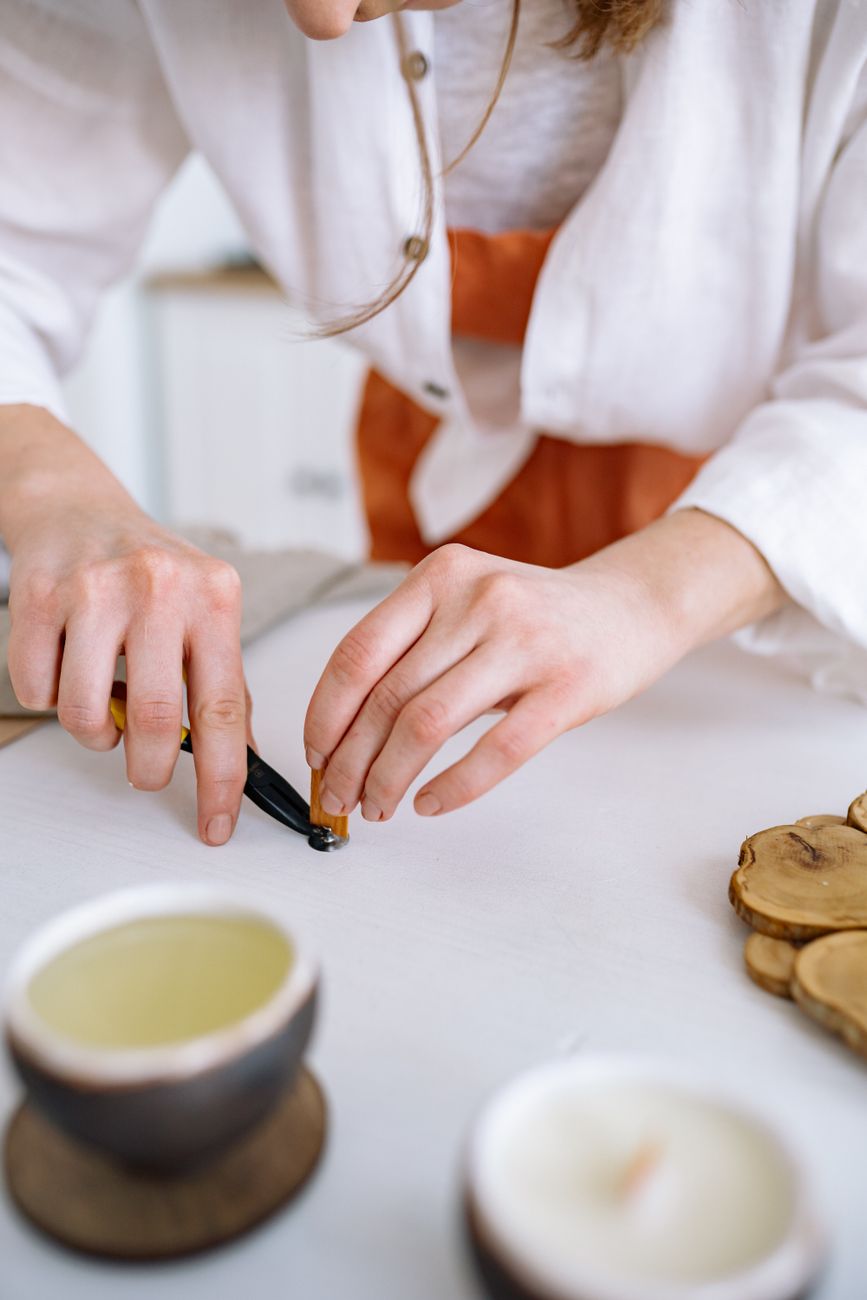
It started in a garage off Bonnie Brae
I'm Jordan Price. In 2019 I bought a two-pound bag of soy flakes and a cheap digital scale because the candles I liked cost thirty-two dollars and smelled like nothing by the third burn. The first batch tunneled. The second cratered. The twelfth one was pretty good, and I gave it to my neighbor Ruth, who asked for four more.
For two years the whole operation lived on a folding table in a garage with a box fan in the door. I poured after my shift, labeled at the kitchen counter, and drove orders to the post office on Sunday afternoons. I kept a spiral notebook of every batch — wax lot, fragrance load, ambient temperature, how it burned. I still keep it. It's on shelf five now, and there are nineteen of them.
In 2022 I signed the lease on Suite B at 312 E Hickory Street. It has a concrete floor, a working sink, and enough room for a proper melter and a curing rack. I pour here four days a week. If you knock during pickup hours, I'm the one who answers the door, usually with wax on my apron.
- First batch poured
- March 2019
- Studio opened
- 2022, Hickory Street
- Typical batch size
- 36 jars
- People pouring
- One, plus Ruth at markets
What goes in
Four things, basically. I buy them from suppliers I can call on the phone, and I don't change them without telling you.
-
US-grown soy wax
A single-origin soybean wax grown and processed in the Midwest. No paraffin blended in, no vybar, no stearic acid. Soy burns cooler and slower than paraffin, which is why a 9 oz jar gives you 50 to 55 hours instead of 35.
-
Flat-braid cotton wicks
Unbleached cotton, no lead or zinc core, no wire of any kind. Every scent gets wick-tested on its own — fragrance oils change how wax draws, so the wick that's right for Cedar Smoke is one size wrong for Fig & Black Tea.
-
Phthalate-free fragrance oils
Blended for candles, tested to IFRA category 12, and dosed by weight at 8 to 10 percent depending on the scent. Some blends carry essential oils where they perform; some don't, because citrus essential oil burns off and lavender essential oil goes sharp in heat.
-
Glass, tin, and a cotton label
Thick amber glass from a Dallas distributor, seamless tins for the travel size, and a paper label printed twelve miles from here. The warning label on the bottom is the legally required one, and I'd put it there anyway.
What stays out — and why the list is printed
No paraffin. No phthalates. No dyes. No UV inhibitors, no hardeners, no "fragrance enhancer" powders. No crackling wood wicks, because I've never gotten one to burn evenly through a whole jar and I'm not going to sell you one that doesn't.
Every candle's full ingredient list is printed on the box and posted on its page in the shop — wax, wick fiber, fragrance load percentage, and the vessel material. Candles aren't required to disclose any of that. The word "natural" isn't regulated either, which is exactly why I'd rather show you the numbers than use the word.
If you're sensitive to a particular aroma chemical, email me and I'll send you the supplier's IFRA statement and safety data sheet for whichever scent you're asking about. It takes me about ten minutes and it's a reasonable thing to ask for.
I'd rather tell you a candle has 9% fragrance oil than tell you it's "clean." One of those is a measurement.
Jordan Price, founder
How a batch gets made
Six steps, about three hours of hands-on work, and then two weeks of waiting. The waiting is the part most people skip.
-
1. Weigh
Wax and fragrance both go on the scale, never a measuring cup. A batch of 36 jars is 14 pounds 6 ounces of wax, and the fragrance is weighed to the tenth of an ounce against it.
-
2. Melt and hold
Wax comes up to 185°F in the melter and holds there while I pre-warm the jars on the rack. Cold glass is the number one cause of wet spots — those frosty patches where the wax pulls away from the side.
-
3. Add fragrance at 180°F
Fragrance goes in hot so it binds to the wax instead of sitting in it, then gets stirred slowly for two full minutes. Stir fast and you whip air in, and air means craters.
-
4. Pour at 135°F
I let the pot cool to the pour temperature for that scent — most sit around 135°F — then fill in one steady motion. Jars stay on the warm rack overnight and cool slowly under a cardboard tent.
-
5. Trim, label, inspect
Wicks get trimmed to a quarter inch. Each jar is checked for frosting, sinkholes and a level top, and the ones that fail become seconds for the studio shelf at half price.
-
6. Cure for fourteen days
Soy wax keeps binding with fragrance for about two weeks after the pour. A candle lit on day two smells thin; the same candle on day fourteen fills a room. Nothing ships before it's cured, which is why I sometimes sell out.
Vessels, packing, and the return credit
The 9 oz amber jar is a real drinking glass once the wax is gone. Pop any leftover wax out with hot tap water, wash the jar, peel the label, and it's yours — a tumbler, a pen cup, a propagation jar for pothos cuttings.
If you'd rather not keep it, bring clean empties back to the studio or to any market we're at and take $3 off per jar, up to four jars an order. Returned vessels get sanitized, inspected for chips, and refilled here. Jars that don't pass go to the glass recycling drop on Mayhill.
Orders ship in recycled kraft boxes with paper honeycomb wrap and paper tape. No plastic pillows, no bubble wrap, no foam peanuts. The only plastic that leaves this studio is the clamshell on the wax melts, and I'm still looking for a lid that holds a seal without it.
- Vessel return credit
- $3 per jar, max 4
- Packing materials
- Recycled paper, paper tape
- Jars refilled in 2025
- 811
- Local pickup
- Thu–Sat, 11am–5pm
Where to find us around North Texas
I like selling in person. You get to smell the candle before you buy it, and I get to hear what you actually think, which is worth more than any review. Here's the usual circuit — exact dates go out in the email list a week ahead.
-
Denton Community Market
Saturday mornings, April through November, at 317 W Mulberry. We're usually on the east row near the music stage. Bring your empties.
-
Denton Arts & Jazz Festival
Quakertown Park, last weekend in April. Three days, a tent, and about four hundred candles. It's the biggest weekend of the year and the only one Ruth and I do together.
-
Holiday Makers' Markets
November and December pop-ups in Denton, McKinney and the Dallas Design District. Gift sets, travel tins, and a wrapping table that's free to use.
-
The studio itself
312 E Hickory St, Suite B. Open for pickup and browsing Thursday to Saturday, 11am to 5pm. Knock if the sign says closed and the lights are on — I'm probably just pouring.
Ask me something
Questions about an ingredient, a wick, a custom order, or where we'll be this weekend. I answer my own email, usually within a day.
Come smell them in person — or pick a scent from here
Thursday to Saturday, 11am to 5pm at 312 E Hickory St, Suite B. Or read the note breakdowns and order a cured jar online.